- 9802073836
Common Mistakes First-Time Visitors Make When Booking Hotels in Nepal
Every year, thousands of travelers arrive in Nepal with a trip planned down to the last detail, except for the one thing that quietly determines whether the whole trip feels smooth or stressful: where they're staying. Booking a hotel here isn't quite like booking one in Bangkok or Barcelona, and the small differences trip people up more often than you'd expect.
We've watched this happen at Taleju Boutique Hotel more times than we can count. A guest arrives looking exhausted and a little rattled, not because Nepal itself was difficult, but because something about the booking process didn't go the way they assumed it would. Most of these problems are avoidable once you know what to look for. So here's an honest rundown of the mistakes we see most often, and how to sidestep them before your trip even begins.
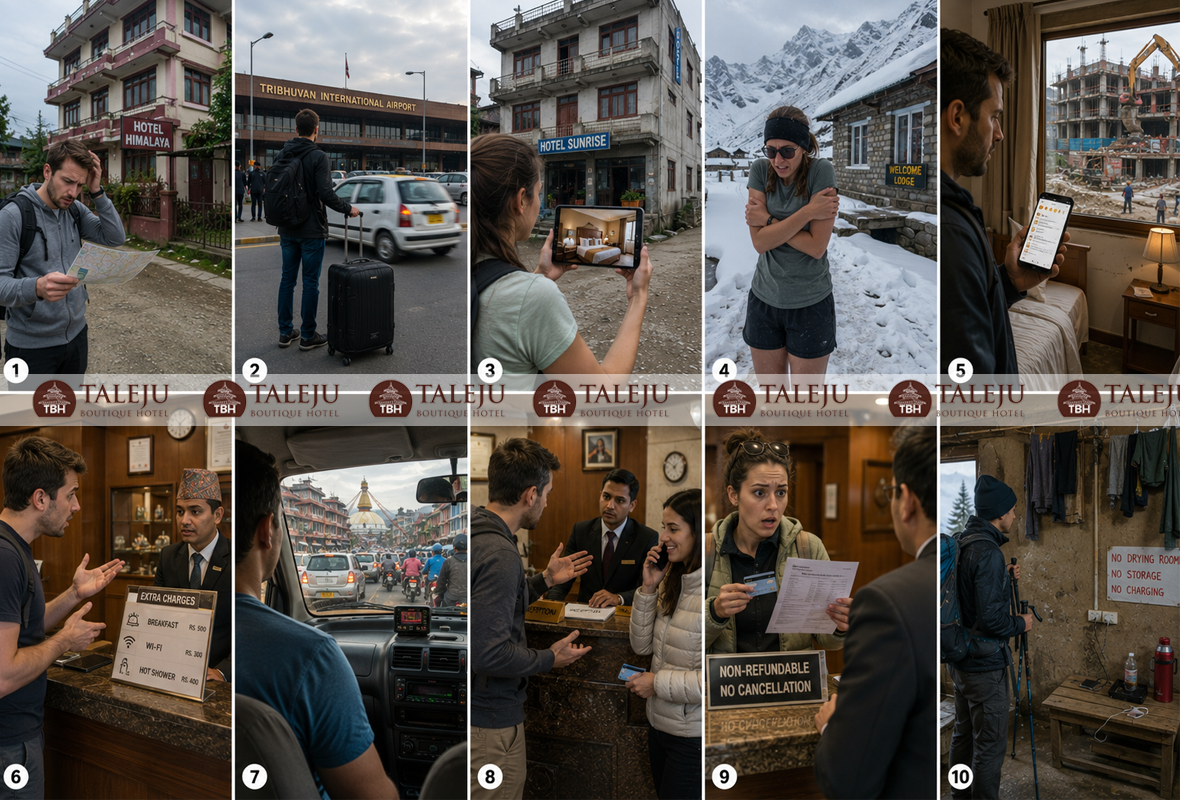
1. Assuming "City Center" Means What It Says
This is probably the single biggest source of confusion for first-time visitors to Kathmandu. Booking platforms love the phrase "city center," and in a lot of cities, that phrase is reasonably accurate. In Kathmandu, it can mean almost anything.
The city doesn't really have one center in the way that, say, Paris has a clearly defined core radiating out from a single point. There's Thamel, the backpacker and tourist hub packed with shops, restaurants, and nightlife. There's Durbar Square, the historic heart of the old city. There's the newer business districts further out. A hotel listed as "central" might be a fifteen-minute walk from Thamel or a twenty-minute taxi ride from Durbar Square, and the listing won't always make that distinction obvious.
Before booking, pull up the actual address on a map and check the walking or driving distance to the specific sites you care about. Don't rely on the marketing description alone. A few extra minutes of map-checking can save you an hour of confused wandering with a suitcase on your first night.
2. Not Accounting for the Airport Transfer
Kathmandu's Tribhuvan International Airport isn't huge, but arrivals can be slow, chaotic, and disorienting if it's your first time. A lot of travelers book a hotel without thinking through how they'll actually get there, and end up negotiating with taxi drivers at midnight, jet-lagged, with no local currency and no idea what a fair price looks like.
Many boutique hotels, including ours, offer airport pickup for a flat fee or sometimes for free depending on the booking. It's worth asking about this directly before you arrive rather than assuming it exists or assuming it doesn't. If a hotel doesn't offer pickup, ask them for a reasonable price range for a taxi so you're not negotiating blind the moment you land.
3. Booking Based on Photos Alone
Photos can be deceiving anywhere, but the effect seems amplified with older or converted buildings, which describes a lot of boutique properties in Kathmandu's historic districts. A wide-angle lens and good lighting can make a modest room look spacious and bright. It's not necessarily dishonest, but it's not the full picture either.
Before booking, read through recent written reviews specifically looking for mentions of room size, natural light, and noise levels. These are the three things photos struggle to convey honestly, and they're also the three things that most affect how comfortable your stay actually feels after a long day of sightseeing.
4. Ignoring the Altitude and Season
This one surprises people who aren't used to thinking about geography when booking a hotel. Kathmandu sits at roughly 1,400 meters above sea level, and depending on when you visit, temperatures swing more than travelers expect. Many older buildings and traditional guesthouses don't have central heating, and air conditioning isn't universal either.
If you're visiting in winter, ask specifically whether the room has heating, and if so, what kind. Space heaters are common but not always included automatically, sometimes they're available on request. If you're visiting during monsoon season, ask about how the property handles humidity and whether rooms have proper ventilation. These aren't questions that occur to most first-time visitors until they're already shivering under a thin blanket at 11 p.m., but a two-line message to the hotel beforehand solves the problem entirely.
5. Trusting Star Ratings Without Reading the Reviews Behind Them
We touched on this in an earlier post about review manipulation, but it's worth repeating here in a more practical way. A high star rating tells you very little on its own. What matters is the pattern underneath it.
Look at how many reviews a property has, not just its average score. A hotel with a 4.9 rating from twelve reviews is a much bigger gamble than a hotel with a 4.5 rating from four hundred reviews. Read a handful of the three-star and four-star reviews specifically, since those tend to be the most detailed and least polarized. Five-star reviews are sometimes written quickly out of politeness, and one-star reviews are sometimes written out of frustration over something unrelated to the property itself, like a flight delay or a payment issue. The middle reviews usually give you the clearest, most balanced picture.
6. Not Confirming What's Actually Included
Nepal's hospitality market has a wide range of pricing structures, and what counts as "included" varies a lot more than travelers from more standardized markets expect. Breakfast might be included at some properties and charged separately at others. Wifi is usually free but not always fast enough for video calls. Hot water, surprisingly, isn't a guarantee at every budget property, and even some mid-range guesthouses run on solar heating systems that work better at certain times of day than others.
Before booking, send a quick message asking three things directly: is breakfast included, is hot water available 24 hours a day, and what the wifi speed is actually like. Most properties, including boutique ones like ours, are happy to answer honestly, and the answers will save you from unpleasant surprises on your first morning.
7. Booking Too Far from Where You'll Actually Spend Time
This mistake usually comes from planning a Nepal trip the way you'd plan a European city trip, assuming you'll base yourself in one place and take day trips from there. Nepal doesn't always work that way. If your itinerary includes trekking regions, a stay in Pokhara, or time in Chitwan National Park, booking a single hotel in Kathmandu for your entire trip can mean a lot of unnecessary backtracking.
Think through your full itinerary before locking in accommodation. It's often more efficient, and sometimes cheaper overall, to book shorter stays at multiple properties that match each leg of your trip rather than one hotel that requires long detours partway through.
8. Underestimating the Value of Direct Communication
A lot of travelers book entirely through a third-party platform and never communicate directly with the property before arrival. This works fine at large international chains with standardized processes, but at smaller boutique hotels in Nepal, direct communication often makes a real difference.
Sending a short message after booking, introducing yourself, mentioning your arrival time, and asking any specific questions, tends to get you better service and clearer answers than relying on the platform's default booking confirmation alone. Smaller properties often don't have large front-desk teams monitoring every platform in real time, so a direct message, even just over WhatsApp or email, tends to get a faster and more personal response.
9. Overlooking Cancellation and Payment Policies
Nepal's payment infrastructure has improved a lot in recent years, but it's still not perfectly uniform. Some properties require a deposit paid in advance through international transfer, which can come with unexpected fees depending on your bank. Others only accept cash on arrival, which means you need to have Nepali rupees ready, since not every hotel accepts cards even if the booking platform implies otherwise.
Read the cancellation policy carefully too. Some smaller properties have stricter cancellation windows than travelers expect, given how flexible policies tend to be with larger international chains. If your travel plans have any uncertainty, whether due to trekking permits, flight connections, or visa processing, it's worth asking directly about flexibility before you commit.
10. Not Asking About Altitude-Related or Trek-Specific Services
If your Nepal trip includes any trekking, even a short one, it's worth checking whether your hotel can help with logistics beyond just the room itself. Some boutique hotels, including ours, can help arrange permits, connect you with reliable guides, or store extra luggage while you're away on a trek. This isn't standard everywhere, so it's worth asking specifically rather than assuming.
Skipping this step means a lot of travelers end up scrambling for permit offices and gear rental shops on their own, losing a day or more of their trip to logistics that a hotel could have helped streamline in advance.
A Simple Pre-Booking Checklist
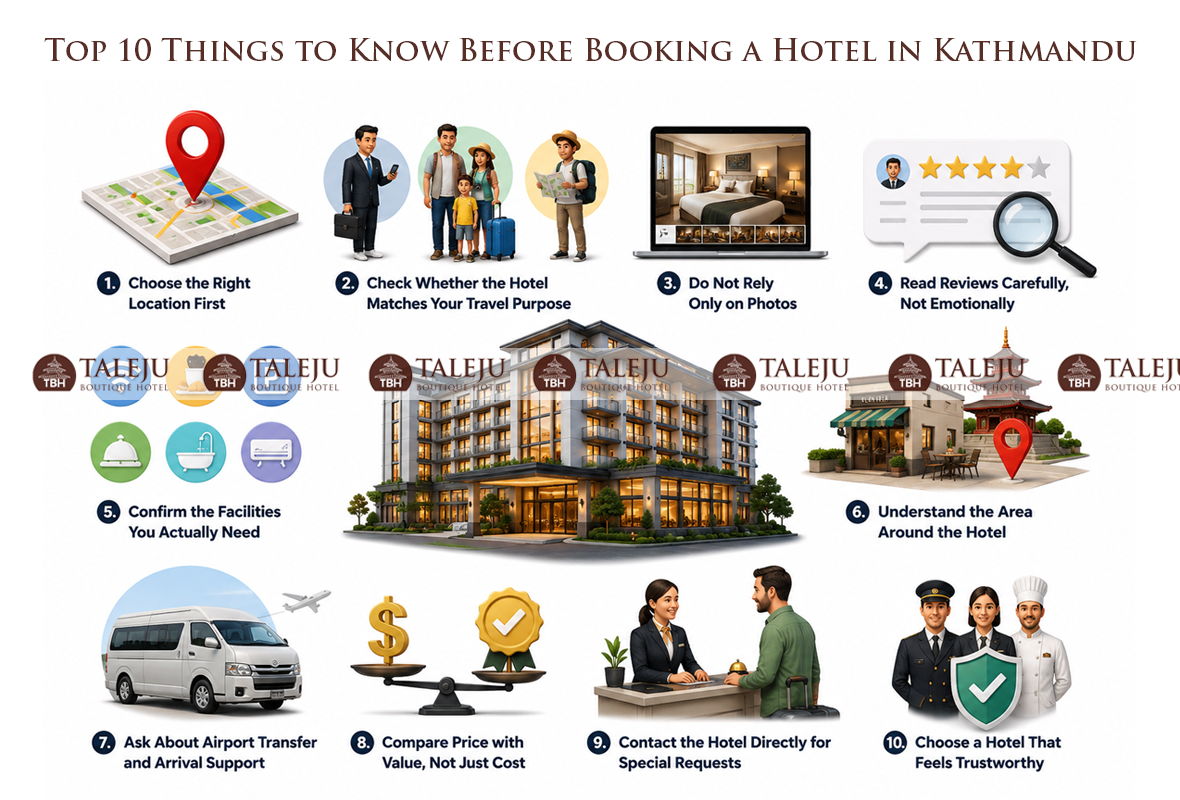
If you take nothing else from this post, here's the short version. Before you book any hotel in Nepal, confirm the exact walking distance to the sites you care about most, ask whether airport transfer is available, read the three- and four-star reviews rather than just the average rating, confirm what's actually included in the price, and send a direct message to the property with any specific questions about heating, hot water, or trek logistics.
None of this takes more than fifteen or twenty minutes, and it's the difference between arriving in Nepal feeling confident about where you're staying and arriving with a nagging sense that you might have booked the wrong place.
Why We Bring This Up
We're not writing this to sell you on Taleju Boutique Hotel specifically, though we'd be glad to have you. We're writing it because we've watched enough first-time visitors work through these exact confusions in our own lobby, and we'd rather help future travelers avoid the stress altogether, whether they end up staying with us or somewhere else entirely.
Nepal rewards travelers who arrive a little prepared. The mountains, the temples, and the food are worth every bit of the trip. The hotel booking shouldn't be the part that goes wrong. A little research before you book, and a few honest questions sent directly to the property, go a long way toward making sure it doesn't.