- 9802073836
Beyond Everest: Discover the Cultural Side of Nepal from Kathmandu
Ask anyone what they know about Nepal, and Everest usually comes up first. It makes sense. The world's highest peak has a way of grabbing attention. But here at Taleju Boutique Hotel, tucked right in the heart of Kathmandu, we meet travelers every week who tell us that once they slow down and actually spend time in the city, the mountains stop being the whole story. Nepal's real character lives somewhere else too: in the old squares, the temple courtyards, the smell of incense drifting through a narrow alley, and the sound of a bell being rung by someone who has walked the same path to that same shrine their whole life.
If you want cultural experiences in Nepal that go past the trekking posters, Kathmandu is where you begin.
A City Built on Layers of History
Kathmandu Valley has been a meeting point for traders, monks, and travelers for well over a thousand years. Sitting between India and Tibet, it absorbed ideas from both sides and turned them into something that feels entirely its own. You can still see it in the carved wooden windows, the pagoda style temples, and the quiet courtyards hidden behind doors you might otherwise walk right past.
This is really the heart of Kathmandu heritage. The valley once held three separate kingdoms, each with its own royal square: Kathmandu Durbar Square, Patan Durbar Square, and Bhaktapur Durbar Square. They share a similar architectural language, but each has its own personality, shaped by the artists and kings who built it.
Bhaktapur especially feels frozen in a gentler time. The brick lanes, the pottery workshops, the old Newari houses all move at a slower pace. Walk through early in the morning and you will see women arranging marigolds for temple offerings, potters working clay wheels by hand, and elders sitting on the temple steps talking, much the way their families likely have for generations.
Where Hinduism and Buddhism Live Side by Side
One of the things guests at our hotel often mention is how naturally Hinduism and Buddhism sit next to each other here. Not as rivals, but as two threads of the same everyday life. It is common to find a Buddhist stupa a short walk from a Hindu shrine, both covered in prayer flags and marigolds, both full of people praying.
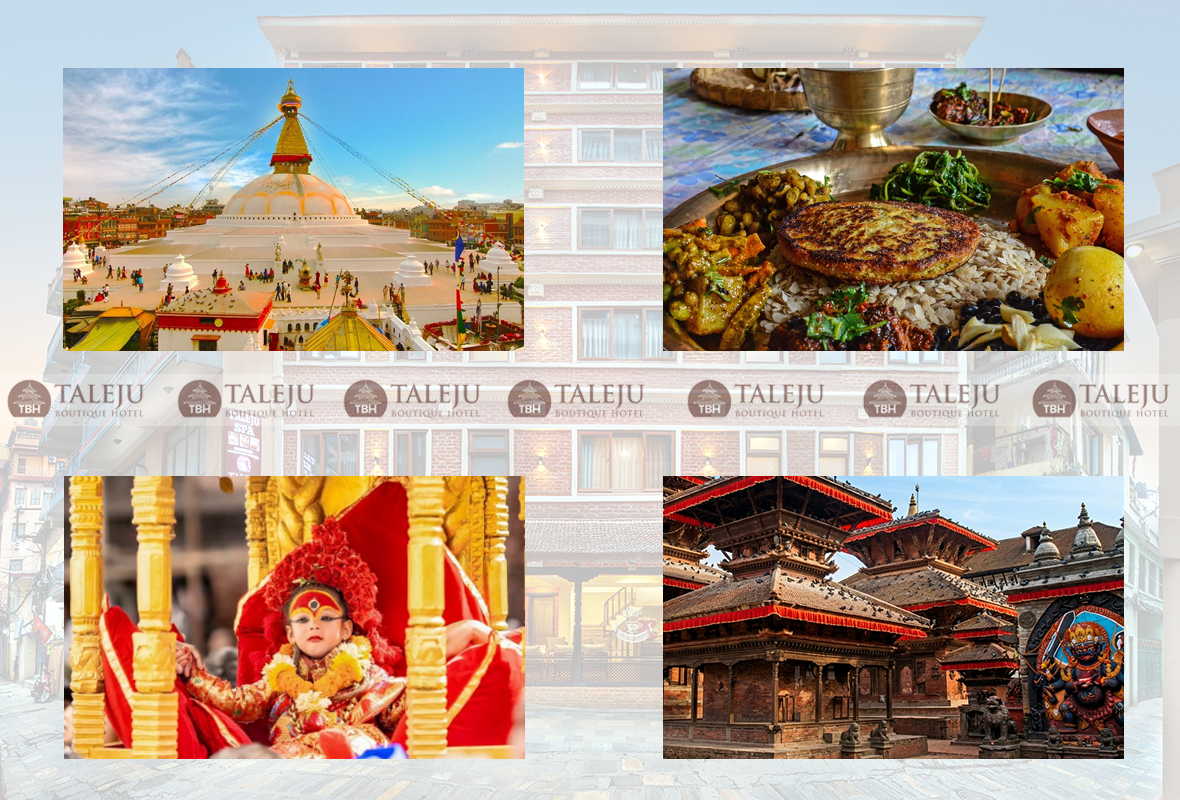
Swayambhunath, perched on a hill above the city and known locally for its resident monkeys, captures this well. Buddhist monks chant there, yet Hindu deities are enshrined within the same complex. Not far away, Pashupatinath Temple draws Hindu pilgrims from across the region to honor Lord Shiva, while the enormous white dome of Boudhanath Stupa remains a spiritual center for Kathmandu's Tibetan Buddhist community.
This blending is not just tolerance for the sake of it. It comes from centuries of shared festivals, shared neighborhoods, and shared families. Many Nepalis move between both traditions without seeing any contradiction at all, offering prayers at a Hindu temple in the morning and lighting a butter lamp at a Buddhist shrine that same evening. Watching this coexistence up close is, for many of our guests, one of the most memorable cultural experiences in Nepal.
Nepal's Traditional Festivals
If you really want to understand a place, watch how its people celebrate. Nepal's traditional festivals are not occasional events tucked into the calendar. They shape the rhythm of the entire year, and many of the biggest celebrations play out right in the old squares of Kathmandu.
Dashain is the longest and most important Hindu festival in the country, usually falling in September or October. Families travel from across Nepal and abroad to be together. You will see bamboo swings built for children, kites filling the sky, and the smell of festive cooking coming from nearly every kitchen in the city.
Tihar, the festival of lights, follows soon after. Homes are decorated with oil lamps and colorful floor patterns, and the festival includes days set aside to honor crows, dogs, cows, and even siblings. It says a lot about the culture here that even animals get their own day of appreciation.
Indra Jatra belongs specifically to the Kathmandu Valley. It honors Indra, the king of gods, and it is one of the best times to see the valley's Newari heritage on full display, with masked dances, chariot processions, and the appearance of the Kumari, Nepal's living goddess, who is paraded through the old streets.
Buddhist communities have their own major celebration too. Buddha Jayanti marks the birth of Siddhartha Gautama and turns Boudhanath and Swayambhunath into places of quiet devotion, chanting, and butter lamp offerings.
If your trip lines up with any of these festivals, take it. There is no better way of exploring Nepali culture than standing in a crowd that has gathered for the same reasons their grandparents did.
Local Cuisine: A Taste of Everyday Nepal
Food says a lot about a place, and Nepali cuisine tells a story shaped by geography, religion, and centuries of trade along Himalayan routes. Meals here are rarely rushed. They are social, often shared, and sometimes tied closely to ritual.
Dal bhat, a plate of lentil soup with rice, vegetables, and pickles, is eaten by most households at least once a day, often twice. There is a well known local phrase, "dal bhat power, twenty four hour," a lighthearted nod to how central this simple meal is to daily life and energy here.
Kathmandu's Newari community has its own food traditions, quite separate from typical Nepali dishes. A proper Newari feast, called a bhoj, might include chatamari (sometimes called Nepali pizza), bara made from lentils, spiced meat dishes, and yomari, a sweet dumpling reserved for festival occasions. Trying a Newari thali in Patan or Bhaktapur is one of the more authentic food experiences you can have here.
And of course, momos deserve their own mention. These steamed or fried dumplings, filled with meat or vegetables and served with a spicy dipping sauce, have Tibetan roots but have become something close to a national favorite. You will find them everywhere, from small street carts to sit down restaurants, including a few of our own favorites just minutes from the hotel.
Try sel roti too, a ring shaped rice doughnut often made for festivals, and take a moment somewhere along the street to enjoy a warm cup of chiya, spiced milk tea, while watching the city move around you.
Art and Craft Traditions Still Alive Today
Kathmandu Valley has long been known for exceptional craftsmanship, and much of that tradition is still practiced today, not just displayed in museums. Patan is often called the City of Fine Arts, and walking through it you will find metalworkers shaping bronze statues of deities using techniques passed down through generations of Newari artisans.
Thangka painting is another tradition worth seeking out. These detailed Buddhist scroll paintings, often depicting mandalas or deities, take enormous patience, sometimes months for a single piece. Visiting a workshop near Boudhanath gives real insight into both the technique and the meaning behind each design.
Wood carving is everywhere in the city's architecture, from temple struts carved with mythological scenes to the latticed windows found on old Newari homes. In many ways, the temples themselves are open air galleries of woodwork, and several small workshops still use traditional hand tools rather than machines.
Pottery has its own home in Bhaktapur's Pottery Square, where artisans shape clay by hand on old fashioned wheels and lay the finished pieces out in the sun to dry, filling the square with rows of drying pots and bowls.
If you want to bring something home that actually means something, buying directly from these artisan communities, rather than a generic souvenir shop, supports the people keeping these skills alive and comes with a much better story to tell.
Daily Life: The Culture Beneath the Culture
Temples and festivals tend to get the spotlight, but some of the richest cultural experiences in Nepal come from simply watching, or joining in on, everyday life.
Mornings in Kathmandu often start with puja, a ritual of worship carried out at home shrines or nearby temples. It is common to see people circling stupas, spinning prayer wheels, or leaving flowers and incense before they start their day. None of this feels performed. It is just part of the routine here.
The markets tell their own version of daily life. Ason Bazaar in the old city is a busy, colorful stretch of spice sellers, fabric vendors, and fresh produce stalls that has worked much the same way for centuries. Walk through early and you will catch the practical, unpolished side of the culture, the haggling, the greetings between neighbors, the small negotiations that have played out on this same street for generations.
Family life shapes daily culture too. Multiple generations often live under one roof, and respect for elders runs deep, shown in small customs like touching an elder's feet during festival greetings.
Sometimes the simplest moments teach you the most. Sharing tea with a shopkeeper, or being invited to eat with a local family, can tell you more about Nepal than any guidebook. Hospitality here tends to be warm and genuine, and curiosity is almost always welcomed.
A Few Tips From Us at Taleju Boutique Hotel
If you are planning to spend real time exploring Kathmandu's cultural side rather than heading straight for the trails, here are a few things worth knowing.
Hire a local guide, especially for Bhaktapur and Patan, where the history behind what you are seeing adds so much to the experience.
Dress modestly when visiting temples, and always remove your shoes before entering sacred spaces.
Try to time your visit around a major festival if you can. Dashain, Tihar, and Indra Jatra all offer a window into traditions that are still very much alive.
Eat where locals eat. Small family run spots often serve food that is more flavorful and more honest than what you will find at tourist focused restaurants.
Support artisans directly by visiting workshops in Patan or Bhaktapur instead of buying only from souvenir shops.
Slow down. Cultural travel rewards patience. An hour spent sitting quietly in a temple courtyard can teach you more than rushing between five different sites in a single afternoon.
A Deeper Nepal Awaits
Everest may be what puts Nepal on people's travel lists, but it is Kathmandu's temples, festivals, food, and everyday rituals that show you who this country really is. The cultural experiences in Nepal reach far beyond mountain trails. They live in courtyard shrines, in the hands of artisans working bronze and clay, in a shared plate of dal bhat, and in the quiet, easy coexistence of Hindu and Buddhist traditions that has shaped this valley for centuries.
So next time you are planning a trip to Nepal, consider spending a few extra days in Kathmandu before, or even instead of, heading for the peaks. Wander the old squares, try the local food, join a festival if the timing works out, and talk to the people who call this valley home. And if you need a comfortable, welcoming place to return to after a day of exploring, we would love to host you here at Taleju Boutique Hotel.
You will not just see Nepal. You will actually get to know it.